
By Katleho Vuyani Moloi
For years, we’ve spoken about the township economy through a very narrow lens.
When we think township business, we immediately think of spaza shops, taverns, car washes, shisanyamas, and street vendors. While these businesses are the heartbeat of our communities, they cannot be the ceiling of our ambition.
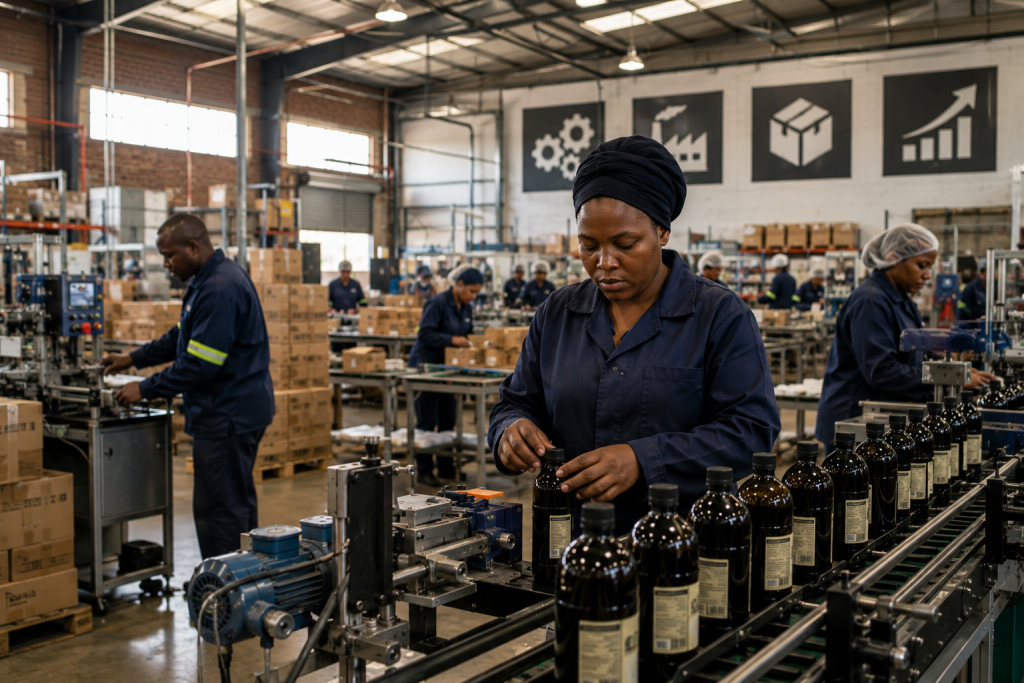
The next chapter of the township economy must be industrialisation.
Not industrialisation on the scale of massive factories alone, but industrialisation that creates products, builds brands, manufactures goods, processes food, develops technology, and produces value that can be sold across South Africa and beyond our borders.
The township economy should not only consume.
It must produce.
One of the most inspiring examples is Soweto Gold. It wasn’t simply another beer. It was proof that a township-born brand could enter a highly competitive manufacturing industry and challenge long-established players. It showed us that excellence is not determined by geography. Innovation does not have a postcode.
Imagine if Soweto Gold wasn’t the exception.
Imagine if every township had manufacturers producing furniture, school uniforms, construction materials, cosmetics, packaged foods, clothing, cleaning products, furniture, pharmaceuticals, renewable energy components, and technology solutions.
That is what industrialisation looks like.
The opportunities already exist.
South Africa imports billions of rands worth of products every year that could, in many cases, be produced locally. Government procurement creates demand. Large retailers require reliable suppliers. Mining houses, banks, hospitals, schools, municipalities, and corporate South Africa spend billions annually buying goods and services.
The question is: why are township manufacturers not supplying more of them?
Industrialisation begins by identifying where township businesses can participate in existing value chains.
It means supporting food processing businesses instead of simply food retailers.
It means building furniture manufacturers instead of only furniture stores.
It means encouraging textile production instead of relying solely on imported clothing.
It means creating packaging businesses, logistics companies, digital manufacturers, recycling plants, agro-processing facilities, and light manufacturing hubs that employ hundreds of people instead of just a handful.
Industrialisation creates something many township economies desperately need: scale.
One factory can support hundreds of suppliers.
One manufacturer creates opportunities for transport businesses, packaging companies, maintenance firms, security providers, accountants, marketers, and technology companies.
One industrial business can create an entire ecosystem.
But if we fail to industrialise the township economy, we risk creating communities that consume far more than they produce.
We will continue importing products into townships while exporting our talent out of them.
We will continue celebrating entrepreneurship while limiting entrepreneurs to businesses with low margins and little opportunity for growth.
And we will continue talking about unemployment while failing to build industries capable of employing thousands of people.
This is where both the public and private sectors have a responsibility.
Government must invest in industrial parks, reliable infrastructure, affordable factory spaces, electricity, broadband, transport networks, and procurement policies that intentionally include township manufacturers. It must make funding easier to access for entrepreneurs who are ready to move from trading to producing.
The private sector has an equally important role. Corporates should not only invest through CSI programmes. They should integrate township manufacturers into their supply chains, transfer technical skills, provide mentorship, open market access, and commit to buying locally produced goods where quality and competitiveness exist.
Industrialisation is not charity.
It is smart economics.
Every successful economy has been built on its ability to manufacture, process, innovate, and export. South Africa cannot achieve inclusive growth if millions of people remain excluded from those opportunities.
The formal economy and the township economy should never be viewed as competitors.
They are partners.
The formal economy has capital, infrastructure, technology, and access to markets.
The township economy has entrepreneurs, local knowledge, resilience, innovation, and an untapped workforce.
Together, they can create something far greater than either could achieve alone.
The township economy has always had entrepreneurs.
Now it is time to produce industrialists.
Because the future of our townships will not only be measured by how many businesses we start, but by how many products we make, how many brands we build, how many factories we open, and how many jobs we create.
The township economy is not South Africa’s second economy.
It is South Africa’s next industrial economy, if we choose to build it.