
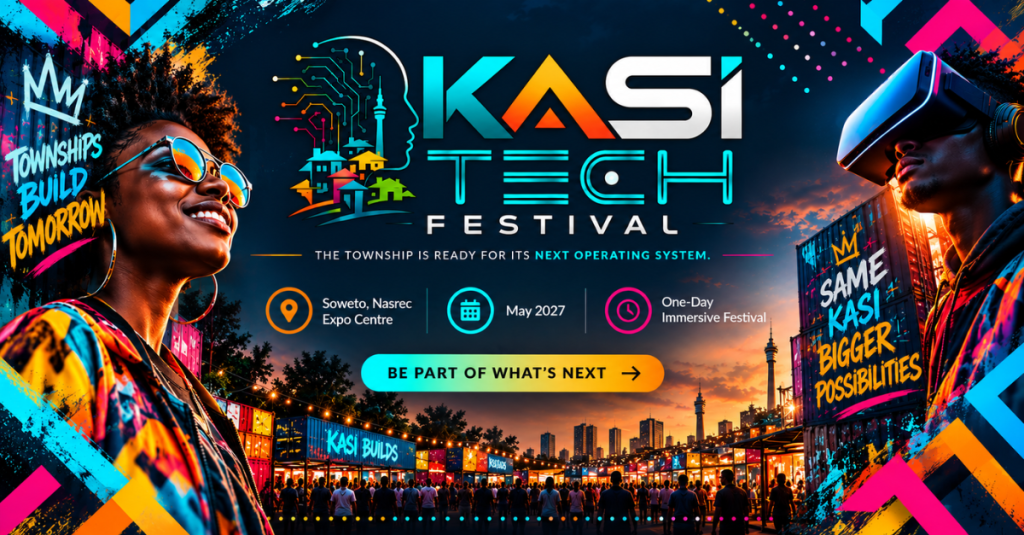
KASI TECH FESTIVAL 2027 May 2027 | Nasrec Expo Centre | Johannesburg
Explore the Kasi Tech Festival and follow the journey towards 2027: www.kasitechfestival.co.za
Artificial intelligence is changing how businesses operate, how customers make decisions and how economies compete. From automating administrative tasks to analysing customer behaviour, forecasting demand and improving productivity, technology is reshaping what businesses can achieve with the resources available to them.
But as the world races towards an AI-powered future, an important question must be asked: Where does the township entrepreneur fit into this revolution?
For too long, technology has been positioned as something that happens elsewhere. Innovation is associated with corporate offices, established technology hubs and well-funded start-ups. Township businesses, meanwhile, are often discussed in terms of survival, informality and limited access to capital.
That narrative must change.
The township economy is not short of entrepreneurial ambition. Across South Africa, people are building businesses in retail, food services, beauty, fashion, transport, construction, entertainment, professional services and countless other industries. What many businesses need is not simply another opportunity to sell, but access to the systems, knowledge and tools that can help them become more productive, competitive and scalable.
AI presents an opportunity to help close that gap.
The real opportunity is not technology. It is what technology makes possible.
Consider a small township business operating with limited staff and a tight budget. The owner may be responsible for managing stock, responding to customers, marketing products, tracking expenses, negotiating with suppliers and finding new opportunities.
Much of the day is spent working in the business, leaving little time to work on the business.
AI tools can help change that equation.
A business owner can use AI to draft marketing content, develop promotional campaigns, respond more efficiently to customer enquiries, organise business information, prepare quotations and explore ways to improve operations. Digital bookkeeping, point-of-sale systems and sales dashboards can provide a clearer picture of what is selling, what is costing money and where improvements are needed.
For a township entrepreneur, these are not abstract technological possibilities. They are practical opportunities to save time, make better decisions and focus on growing revenue.
However, AI is not a substitute for sound business management. Its value depends on how it is applied, the quality of the information available and the entrepreneur’s ability to assess the recommendations it produces. Businesses must also protect customer information, verify important outputs and understand the costs and limitations of the tools they use.
The objective is not to adopt technology for the sake of being modern. It is to solve real business problems.
From informal operations to organised enterprises
One of the biggest opportunities lies in helping township businesses build stronger operating systems.
A business may have loyal customers and consistent demand but still struggle to access finance, supply larger organisations or expand into new markets because its financial records, inventory information and operating processes are not properly organised.
Digital tools can help entrepreneurs maintain records, monitor transactions, track stock, manage customer relationships and produce more reliable business information.
Over time, this can contribute to better business discipline and improved readiness to engage with banks, suppliers, corporate procurement teams and development institutions.
Technology alone will not formalise a business or guarantee access to funding. Registration requirements, financial performance, compliance and other commercial considerations still matter. But better information and more consistent processes can help entrepreneurs take meaningful steps towards building businesses that are easier to assess, support and grow.
This is where AI becomes part of a much bigger economic conversation.
The opportunity is to move more township enterprises from informal operations towards organised, productive and market-ready businesses.
The next generation must become technology creators, not only technology users
There is another dimension to this conversation that deserves greater attention.
Township youth should not only be prepared to use technology developed elsewhere. They should also have opportunities to build businesses, products and solutions of their own.
The next generation of township entrepreneurs could develop digital platforms, AI-powered services, software solutions, e-commerce businesses and technology-enabled services that respond to challenges in their own communities.
These solutions could address local logistics, education, business administration, tourism, payments, property information and access to services.
The advantage of local innovation is that entrepreneurs often understand the problems they are trying to solve. They know the customers, the operating conditions and the everyday realities of the markets they serve.
That knowledge can become a foundation for innovation.
But turning ideas into viable businesses requires more than inspiration. Young innovators need digital skills, mentorship, access to infrastructure, opportunities to test their products, funding pathways and connections to customers.
If South Africa is serious about inclusive participation in the digital economy, township innovation must become part of the country’s broader technology and enterprise development agenda.
Connectivity and affordability still matter
We cannot have a serious conversation about AI in the township economy without addressing access.
Digital transformation depends on reliable connectivity, suitable devices, affordable data, digital literacy and access to tools that businesses can realistically use.
An entrepreneur cannot benefit from a digital service they cannot afford or access. Nor can a business fully adopt AI without understanding how to use it and when it is appropriate.
This means that the responsibility does not rest with entrepreneurs alone.
Technology companies, financial institutions, telecommunications providers, government, educational institutions and business support organisations all have a role to play in making digital adoption more accessible.
The conversation must move beyond showcasing the latest technology. It must address how entrepreneurs can acquire it, learn to use it, integrate it into their businesses and measure whether it is making a difference.
The real measure of success is not how many people attend a technology demonstration. It is how many leave with knowledge, tools and opportunities they can apply in their businesses.
Building an ecosystem that works beyond the event
At Kasi Business News Network, we believe the township economy needs more than occasional conversations about entrepreneurship. It needs a connected ecosystem that links information, technology, skills, business opportunities and market access.
This thinking informs our development of the KBNN Hub, a digital platform intended to connect township businesses with relevant stories, opportunities, resources and business intelligence.
We are also developing Javas, a township-business-focused AI agent intended to help entrepreneurs access relevant information, guidance and resources to support everyday business decisions.
These initiatives form part of a wider ambition: to make technology more relevant to the realities of township enterprise and to help entrepreneurs access tools that can support their growth.
The Kasi Tech Festival, planned for May 2027, will extend this conversation into a practical environment where entrepreneurs, innovators, technology companies and other stakeholders can engage with solutions for the township economy.
The aim is to move beyond talking about what technology might do and begin demonstrating how it can work in practice.
These initiatives are being developed with the understanding that technology adoption must be accompanied by skills, trust, responsible use and access to real commercial opportunities.
The township economy must be part of the AI economy
South Africa cannot build an inclusive digital economy if township businesses remain spectators in the technology revolution.
The question is no longer whether AI will influence how businesses operate. It is whether township entrepreneurs will have the tools, skills and support to benefit from that change.
We must begin treating technology as business infrastructure: just as important to future competitiveness as financial management, access to customers, reliable suppliers and sound business planning.
That requires a shift in how we think about township development. We must invest not only in helping businesses survive, but in helping them become more productive, more connected and capable of competing in larger markets.
We must support entrepreneurs who use AI to improve existing businesses, while creating space for the next generation to build technology companies of their own.
And we must ensure that the township economy is represented in the conversations, partnerships and investments shaping Africa’s digital future.
The township has always had entrepreneurs who identify opportunities where others see challenges. The next step is to give those entrepreneurs greater access to the technology, information and infrastructure that can help them turn ambition into scale.
The AI revolution must not simply reach the township. It must create opportunities for the township to participate, innovate and build.
Because the future of the township economy will not be determined by technology alone, but by who has access to it, who knows how to use it, and who gets the opportunity to build with it.