In global financial history, the phrase “Barbarians at the Gate” captured the ruthless ambition of outsiders trying to break into the tightly held bastions of power. It referenced the 1988 leveraged buyout of RJR Nabisco and became symbolic of disruption knocking on the doors of elite spaces.
Today, in South Africa, a different set of disruptors stands at a different kind of gate: township entrepreneurs — ambitious, resourceful, and determined — seeking access to the economic ecosystem that remains walled off by red tape, outdated models, and sometimes, outright corruption.
They’re not invaders, but innovators. Yet, they are often treated like outsiders in an economy that should be rooting for their rise.
This economy, often undervalued and underfunded, is not a fringe player. According to The World Bank, South Africa’s informal sector, driven in large part by township businesses, contributes between 6–8% to GDP and supports millions of livelihoods.
But despite this, access to funding remains disproportionately low. Institutions created to serve the small and micro-business sector — such as Small Enterprise Development Agency (SEDA), the National Empowerment Fund (NEF), and Gauteng Enterprise Propeller (GEP) — often operate with funding models better suited for established firms than first-time, township-based entrepreneurs.
“We’re not asking to be saved. We’re asking to be seen,” says Katleho Moloi, founder of Kasi Business News Network (KBNN). “The system wasn’t built for us — and you feel that every time you apply for funding.”
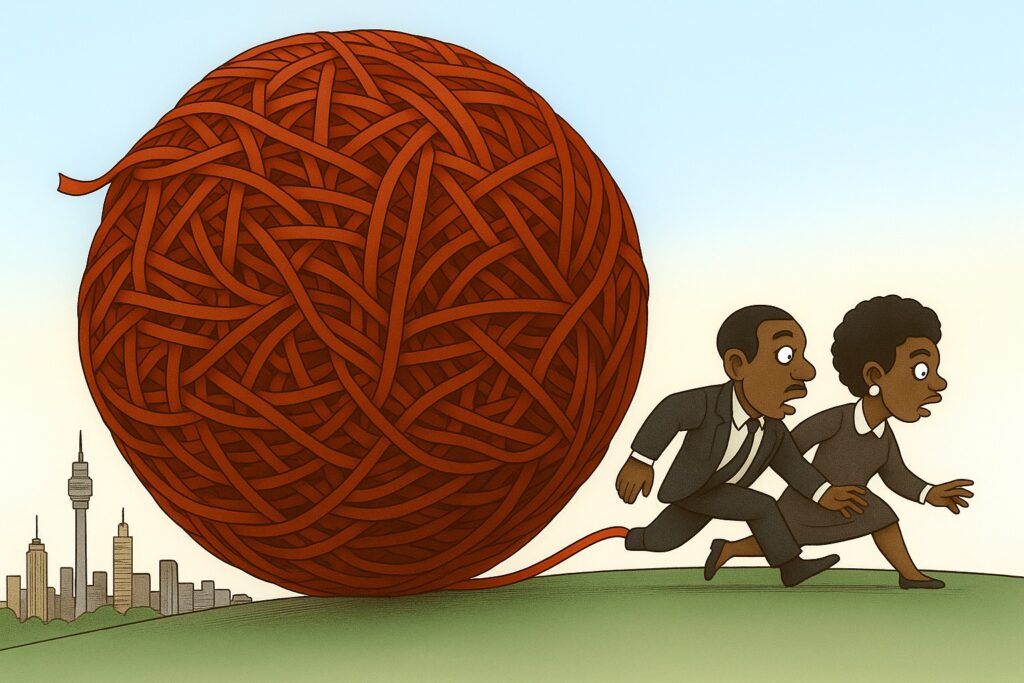
As Moloi has noted that red tape has started to feel like a “moat around the castle”.
While funding agencies were set up to be enablers, they have become fortresses of bureaucracy.
Application processes can take months. Requirements include audited financial statements, tax clearance, compliance documents, collateral guarantees, and five-year financial projections — hurdles that many early-stage entrepreneurs simply cannot clear.
This resembles what development economists call “structural exclusion,” where systems unintentionally filter out the very people they’re supposed to serve. Instead of being flexible and developmental, the criteria reward the polished, connected, and already-capitalized.
“The paradox,” Moloi adds, “is that the only way to qualify for support is to already not need it.”
At the heart of the problem is the idea of collateral.
Township entrepreneurs rarely have fixed property, credit history, or personal savings to pledge. Yet many funding instruments still require guarantees — a model inherited from formal banking, not grassroots development.
As Nobel Prize-winning economist Muhammad Yunus famously argued, “If you are not creditworthy in the conventional sense, the solution is not to abandon you — it is to reimagine credit.”
Until South Africa adopts a similar posture, the funding gates will remain closed to the vast majority of emerging entrepreneurs.
Corruption sets in when the gatekeepers, once trusted to protect the system, become takers themselves.Beyond bureaucracy lies a more sinister problem — the informal networks of corruption that shape outcomes behind closed doors.
Entrepreneurs speak of “facilitation fees” — bribes disguised as paperwork costs — or being encouraged to work with consultants who “know someone inside.” Some are even told that getting funding will require partnerships with politically connected players who will claim equity in the business.
“You begin to wonder if the system was ever meant to help people like us,” says Moloi. “It feels like it’s designed to look fair, but act selectively.”
A 2022 report by Corruption Watch South Africa highlights the alarming rise in procurement-linked corruption within government-linked development agencies — a pattern that affects the SMME landscape directly.
Even when funding is disbursed, it often follows a quota-based logic: fund a few projects, showcase them in glossy reports, and meet the KPIs.
But what about sustainability? Impact? Business survival?
This reflects what author and development scholar Ha-Joon Chang calls “policy optics” — doing just enough to look effective without addressing root problems.
The result? A rotating cast of “funded entrepreneurs” who are celebrated publicly, but struggle privately. Real transformation remains elusive.
What Needs to Change?
If we are serious about breaking open the gates of economic access, several reforms are urgent:
- Redesign Funding Models
Create funding instruments that understand early-stage risk — using mentorship, phased disbursement, and character-based assessments over traditional credit scoring. - Simplify the Process
Digitise and streamline applications. Remove excessive requirements. Trust in people’s ideas — not just their documents. - Root Out Corruption
Establish independent review panels. Protect whistleblowers. Introduce transparency scorecards for funding agencies. - Build Entrepreneur-Led Ecosystems
Let township entrepreneurs shape the criteria, the programmes, and even the fund structures themselves. - Fund Potential, Not Just Paperwork
The next great business won’t always come with a perfect business plan. But it will come with passion, purpose, and persistence.
Township entrepreneurs are not looking to storm the gates. They are builders — of businesses, of communities, and of a new economic reality. But they need tools, not barriers. Trust, not tokenism. Real partnership, not patronage.
“We are not the barbarians,” Moloi concludes. “We are the builders. All we’re asking is that the doors be opened — not because we’re entitled, but because we’re ready.”
The township economy is not a threat. It is the greatest untapped opportunity in the South African economy. And it’s time the system stopped fearing the knock at the gate — and started welcoming the future in.
The image is a AI generated image which has drawn inspiration from Peter Schrack’s ‘The High Cost of Red Tape In Nigeria’